


Theme 1: Phylogenomics and Biodiversity Genomics
The diversity of life is the product of macroevolution: the origin of new lineages, their diversification over millions of years, and the transformation of genomes and phenotypes along the branches of the tree of life. Yet every macroevolutionary pattern ultimately emerges from microevolutionary processes acting within populations, such as mutation, recombination, genetic drift and natural selection. Bridging these two scales remains one of the central challenges in evolutionary biology. Genomes provide a unique opportunity to do so, because they record both the population-level processes that generate and sort genetic variation and the deep history of speciation and divergence into which these processes accumulate. Our group studies macroevolution at the genomic level. By generating and comparing genomes sampled densely across entire clades, from all living birds to primates, marsupials and insects, we reconstruct how biodiversity has been generated and investigate the genomic mechanisms that govern the tempo and mode of evolutionary change.
1.1 Rapid radiation and the bird tree of life (B10K)

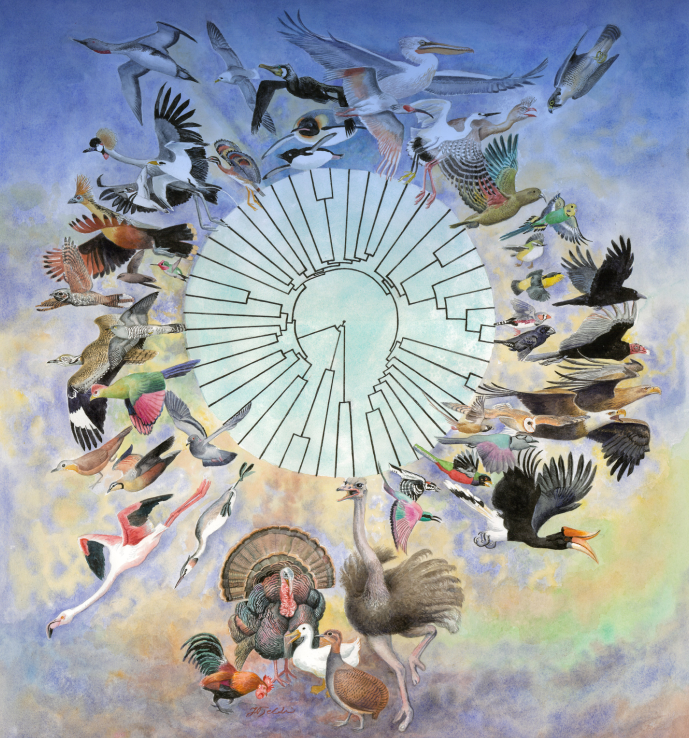
Rapid radiation, in which one lineage splits into many species in a short time, is a major engine of biodiversity. Birds are a striking example: most living orders arose in a burst of diversification around the extinction of the non-avian dinosaurs 66 million years ago. This makes birds an ideal model for studying how radiations happen, but it also makes their phylogeny one of the hardest problems in biology, because short internodes leave little signal and produce many conflicting gene histories.
Through the Bird 10,000 Genomes Project (B10K), we are sequencing all ~10,500 living bird species. Milestone genome-scale phylogenies built from order-level and then family-level sampling have progressively resolved the deep branches of the bird tree. Alongside the tree itself, these genomes are reshaping our understanding of how bird radiation and evolution proceeded — from the demographic and morphological consequences of the end-Cretaceous mass extinction to the drivers of molecular-rate variation across lineages and the responses of bird populations to past climate change. Coverage is now being extended to the genus level.
Representative publications:
- Complexity of avian evolution revealed by family-level genomes. Nature (2024).
- Dense sampling of bird diversity increases power of comparative genomics. Nature (2020).
- Whole-genome analyses resolve early branches in the tree of life of modern birds. Science (2014).
- Species-specific traits mediate avian demographic responses under past climate change. Nature Ecology & Evolution (2023).
- Changes in the functional diversity of modern bird species over the last million years. PNAS (2023).
1.2 Incomplete lineage sorting, reticulate evolution and traits

When a species splits, its descendants inherit gene variants that were already present in the ancestral population. If speciation events follow each other quickly, these variants sort randomly into the new species, so that different parts of the genome tell different stories about who is related to whom. This process, called incomplete lineage sorting (ILS), accompanies nearly every speciation event. When speciation is rapid, ILS can affect a substantial fraction of the genome, making the true evolutionary history look more like a network than a simple branching tree.
Genomic studies have now shown that ILS is pervasive across the tree of life and that it can mislead phylogenetic inference when it is not accounted for. But a deeper question remains largely unexplored: does ILS contribute to the evolution of morphological traits? If a trait is governed by genes whose histories are discordant with the species tree, that trait may be shared by species that are not each other's closest relatives — not because of convergent evolution, but because they inherited the same ancestral variant. Our work is providing the first evidence that this happens, opening a new link between genome evolution and phenotypic diversity.
Representative publications:
- Pervasive incomplete lineage sorting illuminates speciation and selection in primates. Science (2023).
- Incomplete lineage sorting and phenotypic evolution in marsupials. Cell (2022).
- Phenotypic signatures of incomplete lineage sorting in hominids. Trends in Ecology & Evolution (2025).
- A region of suppressed recombination misleads neoavian phylogenomics. PNAS (2024).
- Comparative genomics reveals the hybrid origin of a macaque group. Science Advances (2023).
- Phylogenomic analyses of the genus Drosophila reveals genomic signals of climate adaptation. Molecular Ecology Resources (2022).
1.3 The tempo and mode of mutation rate evolution

Mutation is the raw material of evolution and the root cause of genetic disease, yet the mutation rate itself is not fixed. It differs among species and has changed over evolutionary time. In Tempo and Mode in Evolution (1944), George Gaylord Simpson asked how fast morphology evolves and whether it changes gradually or in bursts. We ask the same questions of the mutation rate.
We connect two timescales. At the microevolutionary scale, we measure new mutations directly in parent–offspring trios across a broad range of vertebrates, revealing that the per-generation mutation rate is itself an evolving trait shaped by generation time and life history. At the macroevolutionary scale, we trace how substitution rates — the mutations that become fixed over millions of years — vary across the bird and mammal trees, and test which traits, from body size and metabolism to flight style, set the pace of genome change. Whether Simpson's framework of rapid bursts and long periods of stasis applies to the mutation rate itself remains an open question.
Representative publications:
- Drivers of avian genomic change revealed by evolutionary rate decomposition. Nature (2025).
- The mutation rate as an evolving trait. Nature Reviews Genetics (2023).
- Evolution of the germline mutation rate across vertebrates. Nature (2023).
- The Mutationathon highlights the importance of reaching standardization in estimates of pedigree-based germline mutation rates. eLife (2022).
- The germline mutational process in rhesus macaque and its implications for phylogenetic dating. GigaScience (2021).
- Flight style and metabolism shape the tempo of genome evolution in birds. PLoS Biology (2026).
1.4 Sex chromosome evolution

Sex chromosomes have evolved independently many times in vertebrates — XY in mammals, ZW in birds, and a variety of genetic and temperature-dependent systems in reptiles, amphibians and fish. Each independent origin is a natural experiment in genome evolution. This raises a basic question: is sex chromosome evolution predictable?
By comparing sex chromosome architecture across mammals, birds and reptiles, we have traced how recombination is suppressed in stepwise stages, how chromosomes degenerate once they stop recombining, which ancestral chromosomes are preferentially recruited as sex chromosomes, and how new evolutionary strata form along individual lineages. These comparisons reveal that sex chromosome turnover is more structured than random — certain genomic features, including the expression of testis-biased genes, predispose particular chromosomes to be co-opted, and environmental change can trigger clusters of new sex chromosome origins. Yet major questions remain open: whether young sex chromosomes are destined to decay, how the sex determination regulatory network itself evolves across transitions, and how changes in that network contribute to sex-biased disease.
Representative publications:
- Genomic predisposition is associated with the direction of sex chromosome evolution. Science (2026).
- Platypus and echidna genomes reveal mammalian biology and evolution. Nature (2021).
- Evolutionary and biomedical insights from a marmoset diploid genome assembly. Nature (2021).
- Complex evolutionary trajectories of sex chromosomes across bird taxa. Science (2014).
- Eighty million years of rapid evolution of the primate Y chromosome. Nature Ecology & Evolution (2023).
- Phylogeny and sex chromosome evolution of Palaeognathae. Journal of Genetics and Genomics (2022).
© Copyright 2026 by Centre for Evolutionary and Organismal Biology, Zhejiang University