



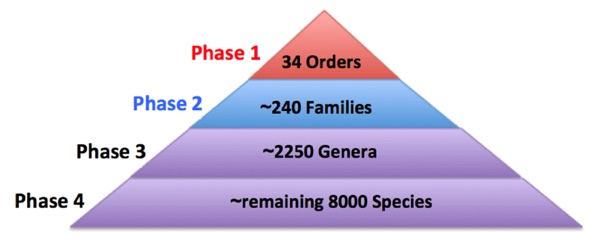
Most living bird orders arose in a burst of diversification around the end-Cretaceous mass extinction 66 million years ago, making birds one of the most species-rich vertebrate classes — and their phylogeny one of the hardest to resolve. B10K aims to generate reference genomes for all ~10,500 extant bird species. A special issue in Science (2014) presented the first genome-scale avian phylogeny from ordinal-level sampling. Two subsequent Nature papers (2020, 2024) extended coverage to the family level, providing the most complete resolution of the deep branches of the bird tree to date. Coverage is being extended to the genus level. The project has collected over 5,000 bird genomes and shares them with the global research community, fuelling studies well beyond phylogenomics: conservation genomics of endangered species, the evolution of vocal learning and cognition, adaptation to extreme environments, biogeographic responses to past and present climate change, and the genomic basis of convergent traits such as flightlessness and dietary specialisation.
B10K project website: b10k.com
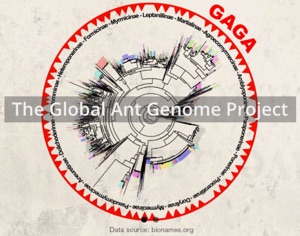
The transition from solitary life to superorganismality is one of the major transitions in evolution, yet its genomic basis remains poorly understood, partly because ants, the largest and most diverse group of superorganismal insects, have lacked broad genomic coverage. GAGA is building a comprehensive genomic resource across the ant phylogeny to trace how genomic architecture was reshaped during independent origins of complex sociality, and to identify the genes and regulatory networks underlying caste determination and division of labour. The first major analysis (Cell 2025) reconstructed the adaptive radiation of ants and linked genomic changes to the evolution of superorganismal traits.

Primates are our closest relatives and a natural system for understanding human evolution and disease. The Primate Genome Project, launched in 2018 with collaborators from over 50 institutions worldwide, aims to sequence all ~520 living primate species. A special issue of Science (June 2023) presented the first major results, genomes from 233 species spanning all 16 primate families, and addressed questions from the tempo of primate genome evolution and pervasive incomplete lineage sorting to the identification of human-specific genomic innovations and their medical relevance. Ongoing work is expanding species coverage and using these genomes to study sex chromosome evolution, mutation rate variation, and the genetic basis of primate-specific traits.
Primate Genome Project results: Science special issue

The human reference genome represents a single consensus sequence and misses the structural variation and population-specific variants that underlie differences in disease risk, drug response, and adaptation. APG is assembling complete, haplotype-resolved genomes at population scale across Asian populations, building a pangenome that captures the full spectrum of human genomic diversity in the region. This resource enables the reconstruction of evolutionary history at the resolution of individual base pairs, tracing natural selection, archaic introgression, and demographic events that have shaped present-day phenotypic and disease variation.
APG project website: genome.zju.edu.cn
We contribute to the Vertebrate Genomes Project (VGP), which aims to produce error-free reference genomes for all ~70,000 vertebrate species, and to the Earth BioGenome Project (EBP), which coordinates the global effort to sequence all eukaryotic life. Both provide foundational resources that our research draws on and feeds back into.