


Theme 2: Evo-devo of Major Transitions
Life's most dramatic changes happen when organisms cross fundamental boundaries — from solitary to social, from one habitat to another, or when a wholly new organ or function appears. We study the genomic and developmental mechanisms behind these major transitions, asking how gene regulation is rewired to produce new levels of biological organization and new body plans.
2.1 The solitary-to-social transition: evo-devo of the superorganism
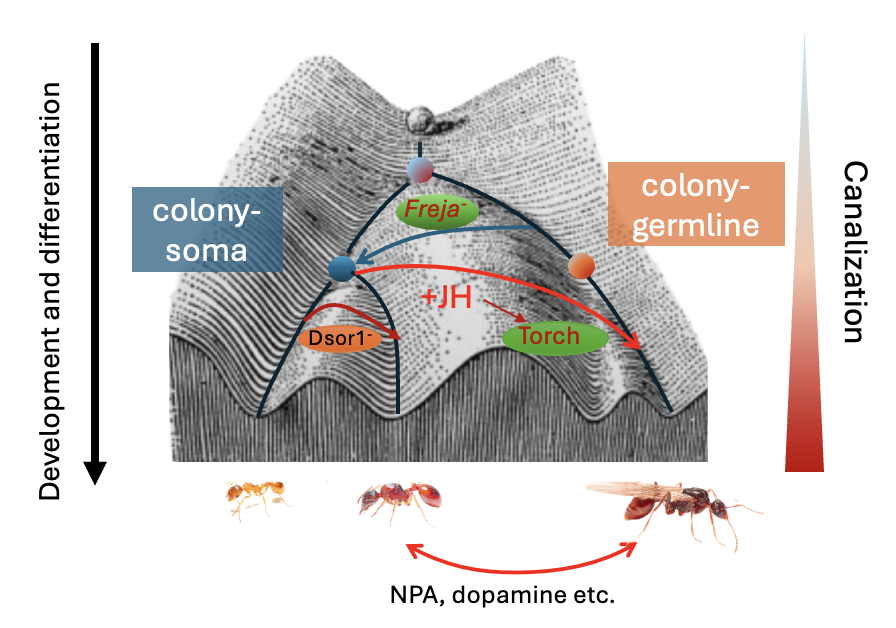
The transition from solitary life to superorganismality is one of the major transitions in evolution, comparable in its consequences to the origin of multicellularity itself. In both cases, formerly autonomous units surrendered their independent reproduction to become parts of a higher-level individual — cells in a body, or castes in a colony. An ant colony, for example, is not simply a group of cooperating individuals: queens, workers and soldiers function as the germline and soma of a single superorganism, developing from one genome through differentiated castes just as a multicellular body develops from one genome through differentiated cell types. Understanding how and why this transition happened is a central problem in evolutionary biology, it asks how natural selection can favour individuals that give up their own reproduction, and how a single genome encodes the developmental capacity to produce radically different phenotypes depending on caste fate.
We approach this problem from both the evolutionary and the developmental side. Comparative genomics across the ant tree of life reveals how genomic architecture was reshaped as ancestors transitioned from solitary life to superorganismal colonies, which genes and regulatory networks changed, and in what order. On the developmental side, single-cell transcriptomics and gene-expression profiling show how a shared genome channels individuals into queen or worker fates through canalized patterns of gene expression during larval development. Meanwhile, neuronal remodelling and neuromodulatory programs govern the division of labour among adult workers and the transition from virgin queen to reproductive foundress. A central open question is whether the regulatory logic underlying caste determination has been reinvented independently each time superorganismality evolved, or whether convergent solutions point to deep constraints on how genomes can encode this level of social complexity.
Representative publications:
- Adaptive radiation and social evolution of the ants. Cell (2025).
- Juvenile hormone as a key regulator for asymmetric caste differentiation in ants. PNAS (2024).
- Canalized gene expression during development mediates caste differentiation in ants. Nature Ecology & Evolution (2022).
- A single-cell transcriptomic atlas tracking the neural basis of division of labour in an ant superorganism. Nature Ecology & Evolution (2022).
- The gene expression network regulating queen brain remodeling after insemination and its parallel use in ants with reproductive workers. Science Advances (2020).
- Towards reconstructing the ancestral brain gene-network regulating caste differentiation in ants. Cell (2018).
- Genomic signatures of evolutionary transitions from solitary to group living. Nature Ecology & Evolution (2015).
- ACaste-specific RNA editomes in the leaf-cutting ant Acromyrmex echinatior. Nature Communications (2014).
2.2 Evolution of organs, functional innovation and novelty

Major transitions in lifestyle demand new organs and functions — whether an organism moves between habitats, adopts a new diet, takes to the air, or shifts its reproductive strategy. Each transition is an evo-devo problem. Where does morphological novelty come from? When a lineage evolves a new structure, does it build from scratch, or repurpose ancestral developmental programs that served a different function? And when independent lineages face the same functional challenge, do they converge on the same genetic solutions?
We use comparative genomics, single-cell transcriptomics, functional genomics and large language models to study how genomes are rewired to produce functional novelty across lineages that have undergone major transitions. A recurring finding is that the raw developmental material often predates the transition itself, key genetic programs for new structures can be traced to ancestors that had no use for them, and were co-opted rather than invented when the opportunity arose. At the same time, regulatory innovation appears to be a general engine of morphological change: lineage-specific conserved regulatory elements can be linked to the evolution of lineage-specific traits, suggesting that rewiring when and where existing genes are expressed matters at least as much as evolving new genes. Single-cell atlases now let us map these changes at the resolution of individual cell types, while large language models trained on protein sequences offer a new way to predict how sequence variation translates into functional change. An open question is whether the reuse of ancestral programs is the rule or the exception and what determines whether a transition proceeds by co-option or by genuine innovation.
Representative publications:
- Tracing the genetic footprints of vertebrate landing in non-teleost ray-finned fishes. Cell (2021).
- Genomic insights into the secondary aquatic transition of penguins. Nature Communications (2022).
- Functional roles of Aves class-specific cis-regulatory elements on macroevolution of bird-specific features Nature Communications (2017).
- Genome and single-cell RNA-sequencing of the earthworm Eisenia andrei identifies cellular mechanisms underlying regeneration. Nature Communications (2020).
© Copyright 2026 by Centre for Evolutionary and Organismal Biology, Zhejiang University